
Parrot Advocacy
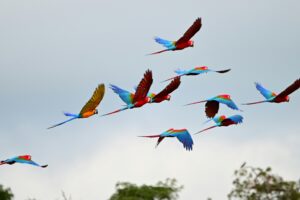
Parrots are unique among companion animals in that they can speak our language. They’re exotic, intelligent, and beautiful, with captivating personalities. Many people are drawn to buying a parrot after seeing online videos of a happy, well-adjusted bird interacting joyfully with its household.
Many of us share our homes with dogs and cats— species domesticated for thousands of years and well adapted to living in human environments. Parrots, however, are not domesticated. They are, in every meaningful sense, wild animals living in our homes. Some companion parrots are still wild-caught, taken forcibly, often violently, from a life of freedom and flock companionship. Even those that are domestically bred are only a few generations removed from the wild, carrying all the powerful instincts of their ancestors with no natural outlet for them.
In the wild, parrots live in flocks of their own species, forming strong social bonds—often for life. In captivity, we remove them from this natural world and confine them to small cages, isolated from flockmates and independence. We clip their wings, depriving them of the defining characteristic of a bird: flight. We limit their choices—when to eat, when to sleep, what to eat (often inappropriate diets), and how much interaction they receive with their own kind, or even with us.
Many behaviors people find “unacceptable” in parrots are, in fact, essential survival mechanisms in the wild. Noise is the number one reason cited for surrender—yes, a Moluccan Cockatoo in full voice is louder than a 747 engine. Disruptive in a home environment, but essential in nature to call the flock across great distances. Chewed the corner off Grandma’s 100-year old china hutch? A parrot’s powerful beak evolved to shred wood for both food and beak health. We bring these magnificent wild animals into our homes and, when they behave as nature designed them to, we label them “bad,” “broken,” or “unmanageable.”
Parrots are among the most frequently surrendered companion animals, usually through no fault of their own. Many people underestimate the reality of living with a parrot—their long lifespans, intense social needs, intelligence, noise, and mess. Life changes such as divorce, illness, financial hardship, relocation, or the death of an owner can also force difficult decisions. In other cases, behavioral issues like screaming, biting, or feather destruction arise when a parrot’s needs aren’t fully understood or met, leaving caregivers overwhelmed and unsure where to turn.
What Becomes of the Bird?
Unwanted parrots face bleak outcomes. Some are passed from home to home, each move increasing stress and trauma. Others are confined to garages, basements, or small cages with little stimulation or social interaction. In the worst cases, parrots are abused, abandoned, released outdoors where they cannot survive, or euthanized because no safe alternative exists.
Parrots bond deeply with their humans and experience loss and upheaval intensely. Repeated rehoming can lead to fear, mistrust, and long-term behavioral and emotional damage. Because parrots can live for decades, a single impulsive purchase can result in a lifetime of instability if proper planning and support are absent. Without knowledgeable intervention, these birds may spend years simply surviving rather than living. Unlike dogs and cats, parrots often fall through the cracks of traditional animal welfare systems, despite being highly intelligent, emotionally complex beings.
But the fortunate ones find refuge with dedicated rescue and sanctuary organizations. These organizations are lifelines. They provide safe refuge, veterinary care, proper nutrition, enrichment, and—just as importantly—love and understanding. Rescues work to rehabilitate parrots emotionally and physically, educate adopters, and advocate for responsible guardianship. They give parrots a second chance at stability, dignity, and joy. In a world where parrots are too often misunderstood and discarded, rescue and sanctuary organizations stand as protectors of both their welfare and their future
The Sockatoo Production Team is passionate about parrot rescue and is honored to support The Oasis Sanctuary and A Tropical Concept Exotic Bird Rescue.
We provide Sockatoos to the birds there and donate a portion of each sale. So your support of Sockatoos also supports a rescue bird.